


Apple's disappointing earnings report triggers post-market plunge, can AI trading's epic rebound continue?
Keywords: Apple earnings, AI trading, earnings guidance, supply chain bottlenecks, chip stocks
Introduction
On the morning of July 31 Beijing time, the US stock market experienced a test of extreme contrasts. On one side, Apple's earnings guidance fell short of expectations, causing its stock to plummet more than 8% in after-hours trading; on the other side, "AI trading" staged a full-scale counterattack, with the Philadelphia Semiconductor Index surging over 8% in a single day, marking its largest gain since April 2025. Behind this intense battle between bulls and bears, market divergence on tech stock valuations and faith in the AI narrative are engaged in a deep tug-of-war.
Apple's earnings guidance below expectations, stock price plummets in after-hours
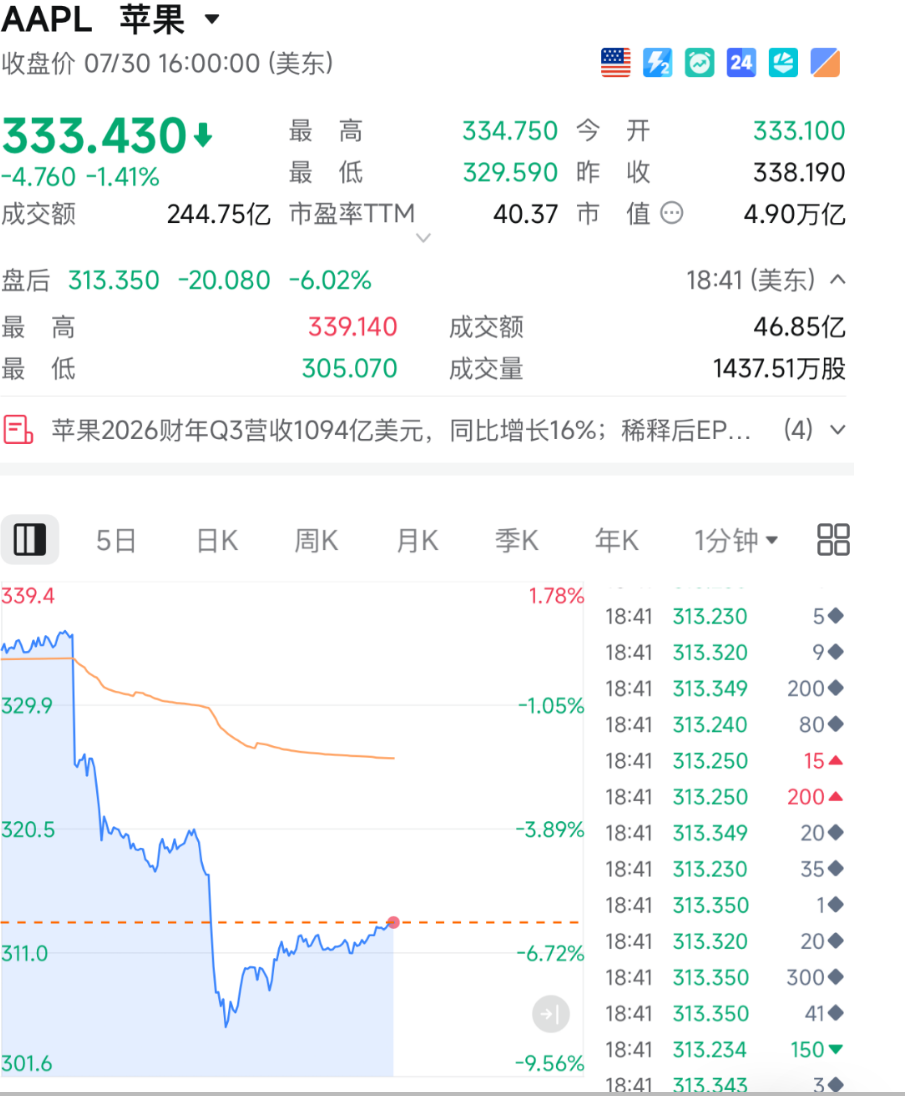
In US after-hours trading, Apple's stock price plummeted, falling more than 8% at one point, and remained down 6.02% as of 6:40 Beijing time. The trigger for this sell-off was Apple's revenue guidance for the fourth fiscal quarter—only growing 9% to 11%, below analysts' consensus expectations.

The latest earnings report shows that in the third fiscal quarter of fiscal 2026 (March 28 to June 27, 2026), Apple achieved revenue of $109.417 billion, a year-over-year increase of 16.36%, slightly exceeding market expectations; earnings per share (EPS) increased by approximately 29% to $2.02, or about $1.91 after excluding one-time factors such as tariff rebates, only $0.02 higher than market expectations. The gross margin rose to 50.1%, demonstrating strong profitability.
Core business performance diverges, service revenue below expectations
By business segment, Apple's third-quarter product revenue reached $78.68 billion, higher than the market's expected $77.25 billion; service revenue was $30.74 billion, below the market's expected $31.36 billion. iPhone contributed $54.25 billion in revenue, showing significant year-over-year growth, accounting for 49.6% of revenue, remaining Apple's core income source; Mac contributed $10.35 billion in revenue, far higher than the market's expected $8.62 billion; iPad contributed $6.19 billion in revenue, below the market's expected $6.89 billion; Wearables, Home and Accessories revenue was $7.88 billion, basically in line with expectations.
Apple's board announced a cash dividend of $0.27 per share, with operating cash flow hitting a historic high. However, based on after-hours stock performance, investors' top priorities are iPhone upgrade cycles, service business growth, and progress on AI-related product launches, rather than short-term cash returns.
Supply chain bottlenecks persist, iPhone price hike risk intensifies
Apple executives made it clear during the earnings conference call that fourth-quarter revenue will be dragged down by two factors: foreign exchange and supply constraints. iPhone revenue growth will slow to around 15% due to supply constraints, and Mac and iPad products will also suffer supply chain impacts.
The current global storage chip supply situation is particularly severe. Cook described it as "a once-in-a-century severe supply gap," and the rush for chip capacity has forced Apple to raise prices for Mac and iPad products. Although Apple has not yet indicated it will raise iPhone prices, many analysts expect the iPhone to be priced higher as early as this year. If this expectation materializes, it could further affect consumer upgrade willingness, putting pressure on Apple's core revenue source.
Amazon's earnings impressive, AWS becomes the biggest highlight
In stark contrast to Apple's gloomy performance, Amazon, which released earnings on the same day, saw its stock surge sharply in after-hours trading, rising more than 10% at one point. The earnings report showed that Amazon achieved revenue of $200.6 billion in the second quarter, a year-over-year increase of 20%; operating profit reached $27.5 billion, a year-over-year increase of 43%. The core cloud computing business AWS contributed $42.2 billion in revenue, higher than the market's expected $40.6 billion, a year-over-year increase of 37%, marking the fastest growth in the past 18 quarters.
Amazon CEO Andy Jassy revealed that AWS's AI business has an annualized revenue scale exceeding $25 billion, maintaining triple-digit year-over-year growth. Amazon expects third-quarter revenue to be between $197 billion and $202 billion, a year-over-year increase of 9% to 12%; operating profit is expected to be between $22.5 billion and $26.5 billion, a year-over-year increase of 29% to 52%. AWS's strong performance confirms that AI infrastructure investment is entering a substantive return period.
AI trading's epic rebound, Microsoft becomes the core engine
In the overnight US stock market, all three major indices rose sharply, with the Nasdaq up 2.78%, the S&P 500 up 1.66%, and the Dow up 1.19%. Large-cap tech stocks mixed, with Microsoft surging more than 15%, marking the largest single-day market cap increase in history; Amazon and Tesla rose more than 3%, NVIDIA rose more than 2%; Meta fell more than 7%, Apple fell more than 1%.
US chip stocks collectively soared, with the Philadelphia Semiconductor Index up 8.19%. In storage concept stocks, SanDisk surged more than 25%, Micron Technology rose more than 18%, and SK Hynix ADR rose more than 17%. The optical communication sector also rose significantly across the board, with Lumentum up more than 17%, and Coherent up more than 15%.
Microsoft is the core engine of this AI rebound. Its earnings report showed that cloud computing revenue has accelerated for consecutive quarters, demand has exceeded existing capacity, and capital expenditures were lower than expected, while maintaining expectations for positive cash flow through fiscal 2027. The market interpreted this as a strong signal that AI infrastructure investment returns are expected, driving the momentum index to its largest single-day gain since 2003.
AI narrative regains trust, medium-term outlook remains optimistic
Microsoft's earnings report conveyed a key signal to the market: ultra-large-scale investment in AI infrastructure is being converted into actual revenue growth, not just capital consumption. This largely alleviated investors' previous concerns about AI bubble formation. Although the Philadelphia Semiconductor Index rose more than 8% in a single day, its cumulative decline in July was still 20%, meaning this rebound was more a result of oversold bounce combined with fundamental verification.
Conclusion
Apple's earnings guidance provides the market with a window for calm observation—even the most powerful tech giant faces tests of supply chain bottlenecks and product cycle transitions. Meanwhile, Microsoft and Amazon's strong performance in AI businesses indicate that the value realization of AI investment is accelerating. Looking ahead, strong corporate earnings, continued AI penetration, resilient economy, and favorable financial environment collectively support an optimistic medium-term outlook for US stocks. However, investors still need to be vigilant about supply chain risks in leading companies like Apple, as well as potential market divergence on AI valuations.