

Behind the PCB pullback in the AI computing power chain: Limited disturbance from market rumors, Industry Logic Still points to long-term prosperity
Key words: PCB, Shenghong Technology, NVIDIA, AI Server, Computing Power Chain, Industrial Logic, Market Rumors, Advanced Packaging
Introduction
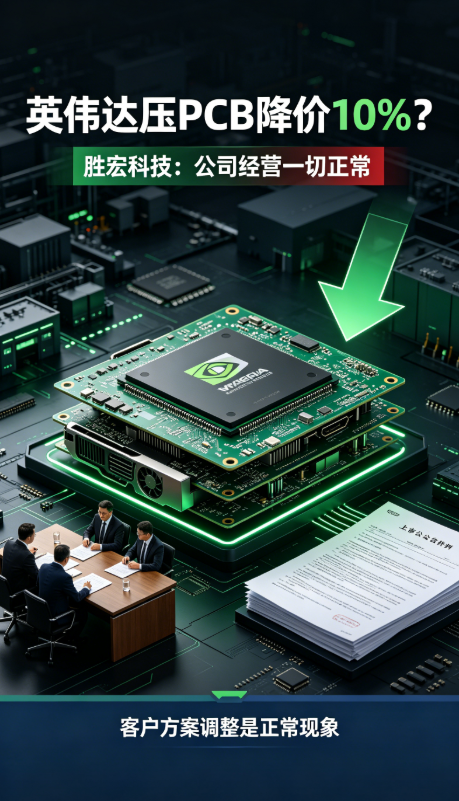
However, from the perspective of the actual operation of the industrial chain, the above-mentioned rumors more reflect the market's sensitive response to high-growth sectors rather than a substantial reversal in the fundamentals. Whether it is the procurement logic of NVIDIA's supply chain or the current supply and demand pattern of the AI PCB industry, both determine that this round of fluctuations is more like a phased adjustment driven by emotions rather than a fundamental change in industry trends.
Rumors have disturbed market sentiment, but Shenghong Technology responds that its fundamentals remain unchanged
On June 24th, a reporter from The Paper called Shenghong Technology as an investor to verify the above rumors. A person who answered the company's phone said that there are many market rumors and the enterprise cannot respond to each one individually. However, it is clear that the company's operations are normal and its fundamentals have not changed.
The above-mentioned person also stated that the customer's choice of the plan is not fixed, and adjustments or improvements during the production process are normal phenomena. The company itself also has certain first-mover advantages. It is suggested that investors take the publicly disclosed information of the company as the standard. In other words, the market's magnified interpretation of a single event does not mean that the actual operation of the industrial chain has fundamentally shifted.
The Shanghai Securities News, citing the views of several industry insiders, also pointed out that the relevant rumors are obviously exaggerated and misinterpreted, among which ";" Shenghong Technology led to the delay of Rubin. This statement lacks industrial logic support. For the AI hardware industry, which is in the stage of technological iteration and capacity ramp-up, factors such as delivery rhythm, certification process, heat dissipation and power consumption calibration are often more decisive than price fluctuations in a single link.
The core contradiction of AI PCB is not the price, but the production capacity and delivery. A person in the PCB industry pointed out that against the backdrop of a shortage of AI PCB production capacity, what customers first care about are delivery capacity and supply stability, and price is not the top priority variable. This is precisely the key to understanding the current revaluation of the industrial chain's value.
Compared with ordinary consumer electronics PCBS, the high-end PCBS used in AI servers have a much more complex structure. Ordinary consumer electronics PCBS usually have only 4 to 6 layers, while AI server PCBS may have more than 20 layers, with precision requirements as high as the micrometer level, and the technical threshold is even close to that of chip manufacturing. Especially in terms of high-density interconnection, signal integrity, heat dissipation control and material stability, the manufacturing process requirements for AI PCBS are much higher than those for traditional boards.
Against this backdrop, AI PCBS are not in oversupply but remain in a state of structural shortage. For downstream customers, the most important thing is not short-term price reduction, but whether the delivery can be completed on time, in the required quantity and according to the specifications. Therefore, enterprises with stronger supply capabilities and deeper technological accumulation actually have more bargaining advantages. For leading manufacturers, this advantage will not disappear due to short-term rumors.
Rubin's delay and Kyber's postponement are more of a technical rhythm issue.
Discussions about the shipment pace of NVIDIA's Rubin platform have led to the emergence of "... "in the market. "Being held back by a certain PCB manufacturer";" According to this statement. However, Ming-te Kung, the research manager of TrendForce, pointed out that the delay of Rubin is mainly related to multiple factors such as the time-consuming HBM4 certification, network transmission upgrade and adaptation, power consumption and heat dissipation solution adjustment. Attributing the delay to a single PCB manufacturer does not conform to the actual situation of the industry.
This indicates that the iteration of AI computing power platforms is not a single-point breakthrough but a systematic project. GPU, HBM, network interconnection, heat dissipation solutions, motherboard materials and even backplane design will all affect the introduction pace of the entire platform. The certification and calibration of any key link may lead to adjustments at the mass production node. Therefore, simplifying complex systems engineering to a single-supplier problem not only makes it easy to misjudge but also may underestimate the true difficulty of technological upgrading in the industry.
Meanwhile, a research report by Jefferies, a foreign bank, has also drawn market attention. It was pointed out that the Kyber backplane PCB solution, which was originally planned to be introduced in 2027, might be postponed to 2028. If the plan is postponed, the global AI PCB and CCL market size in 2027 May be reduced by approximately 5% and 8% respectively compared to the previous forecast. However, the report also emphasizes that this change does not alter the long-term growth logic of the PCB industry. Products such as switch boards and medium boards are still continuously upgrading to higher-specification materials, and the trend of industry upgrading has not reversed.
The competitiveness of Shenghong Technology stems from its high-end manufacturing capabilities and global market share. From the perspective of enterprises, Shenghong Technology is not an ordinary PCB manufacturer, but an important supplier of advanced AI and high-performance computing PCBS. According to its prospectus for listing on the Hong Kong Stock Exchange, the company focuses on the research and development, production and sales of high-end HDI and high multi-layer PCBS. Its core applications cover key equipment such as AI computing power cards, servers, AI servers, data center switches, and general-purpose substrates.
According to Frost & Sullivan data, in terms of the revenue scale of artificial intelligence and high-performance computing power PCBS in the first half of 2025, Shenghong Technology ranked first globally with a market share of 13.8%. Meanwhile, the company has the manufacturing capacity for high multi-layer PCBS with over 100 layers, and has achieved large-scale production of 6-stage 24-layer HDI products, as well as the technical capabilities for 10-stage 30-layer HDI and 16-layer arbitrary interconnection HDI. These capabilities determine their scarcity in the AI infrastructure supply chain.
Financial data also confirm its growth potential. From 2023 to 2025, Shenghong Technology's revenue increased from 7.931 billion yuan to 19.292 billion yuan, and its net profit rose from 671 million yuan to 4.312 billion yuan. In the first quarter of 2025, the company achieved a revenue of 5.519 billion yuan, representing a year-on-year growth of 27.99%. Net profit was 1.288 billion yuan, up 39.95% year-on-year. In high-growth industries, the simultaneous expansion of revenue and profit indicates that they do not rely on short-term themes but are based on real orders and the release of production capacity.
The sector correction does not change the long-term trend, and industrial upgrading is still advancing.
From the perspective of the secondary market performance, on the midday of June 24th, the semiconductor industry chain strengthened against the trend. Advanced packaging, memory, and PCB sectors led the gains. Shenghong Technology's intraday decline narrowed to 0.78%, closing at 335.55 yuan. This change indicates that the market's response to the rumors has mostly remained at the short-term emotional level. As the information gradually clarifies, funds are beginning to return to the industrial logic.
In fact, in the AI era, the demand for PCBS is not only an increase in quantity but also an improvement in specifications. Higher-layer, higher-density, lower-loss materials and more complex interconnection solutions will continue to raise the technical threshold of the industry and also drive leading manufacturers to achieve a higher market concentration. With the continuous expansion of AI servers, switches, and data center infrastructure, PCB, as a core component of basic interconnection, will only enhance its strategic position and not weaken it.
Conclusion Overall, the recent sharp decline in the PCB sector, on the surface, is due to the impact of market rumors, but in essence, it reflects the sensitive game of funds in high-growth sectors. However, from the perspective of industrial logic, supply and demand patterns, and the fundamentals of enterprises, the AI PCB industry is still in a stage where capacity shortage, technological upgrading, and demand expansion occur simultaneously. Short-term rumors are unlikely to change the long-term trend.
The response from Shenghong Technology, the judgment of industry insiders, and the analysis of research institutions all indicate that the pace adjustment of the Rubin platform was not caused by a single supplier, and the delay in the introduction of Kyber does not mean that the growth logic of the industry has been disrupted. For investors, what deserves more attention is not the market noise, but the real demand and manufacturing barriers behind the upgrade of AI hardware.
Against the backdrop of the continuous expansion of AI computing power, the revaluation of the PCB industry is still ongoing. Short-term fluctuations may be inevitable, but what truly determines the height of an industry is always technology, production capacity and delivery capacity, rather than an unconfirmed rumor.