
 < / div >
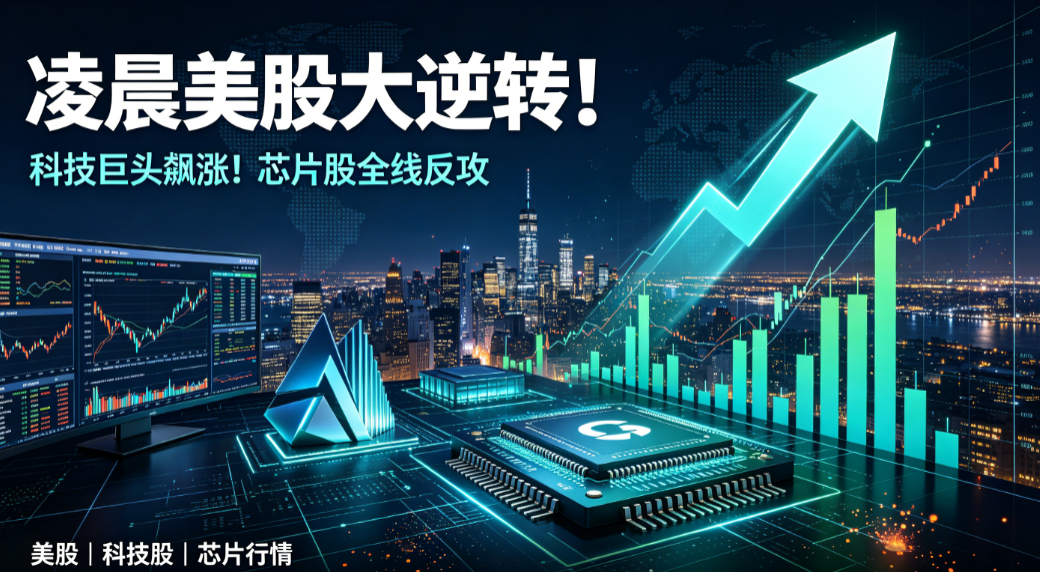
US stocks staged a deep V-shaped reversal: Technology stocks led the gains, oil prices rebounded, and the market sought a new balance amid uncertainty
Key words: US stock market rebound, Nasdaq, technology stocks, chip stocks, international oil prices, US-Iran negotiations, AI investment, market volatilityIntroduction
It is worth noting that the prospects of the US-Iran negotiations have added more uncertainties, pushing international oil prices higher. The capital market is simultaneously digesting two main lines: on one hand, there is the structural growth expectation brought about by technology and AI; on the other hand, there is the risk premium resulting from the situation in the Middle East and the disruption of crude oil supply. Under the interweaving of the two, market volatility has significantly magnified, but it also provides investors with an important window to observe changes in risk appetite.
I. Why Does the US Stock Market have "..." "Deep" Big Comeback
Judging from the market situation, the rebound of the US stock market last night was not driven by a single sector, but rather a simultaneous recovery of technology, large growth stocks and chip stocks. Tesla rose by more than 8%, Google increased by nearly 5%, Amazon climbed by over 3%, Meta and Broadcom rose by more than 2%, and Nvidia also maintained its upward trend. The Dow Jones Industrial Average was able to reach a record high at the close, indicating that funds are not only flowing back to growth sectors but also reconfiguring blue-chip assets with profitability resilience.What is more worthy of attention is the sharp reversal of chip stocks. The Philadelphia Semiconductor Index dropped by more than 3% at one point in early trading, but eventually closed up nearly 4%. Astera Labs, KLA, Applied Materials, Lam Research Group and other individual stocks led the gains. TSMC ADR, ASML ADR, Marvell Technology and others also strengthened one after another. In the short term, this significant fluctuation indicates that the market's profit-taking of the semiconductor sector was relatively concentrated previously. However, in the medium term, the AI computing power chain, the expansion of advanced manufacturing processes, and related capital expenditures remain important logics supporting the valuation of the sector.
The observation from Goldman Sachs 'trading desk is also quite representative: investors paused their pursuit of component and chip stocks on that day and instead resumed buying stocks of hyperscale cloud computing providers and software companies. In other words, the market has not left the technology sector but is rotating within it, from ";" "Hardware + computing power" "Turn to";" "Platform + software + application" The rebalancing.
II. The technology theme remains the core driving force of the US stock market
Goldman Sachs 'judgment went even further. The institution believes that as the second-quarter earnings season of 2026 approaches, with the macro environment remaining solid and the ongoing AI investment boom, corporate profits are likely to perform strongly again this quarter. Meanwhile, the market's focus is shifting from ";" How much did hyperscale cloud computing providers actually spend? Turn to ";" How much return can an enterprise's AI spending bring? . This means that the core of the future earnings season will no longer be merely the scale of capital expenditure, but rather the return on investment, the progress of commercialization and the ability to deliver actual performance.This change is very important. Over the past two years, the market has been willing to pay high valuations for AI concepts because it believes that investment in computing power and infrastructure will open up a new round of the technology cycle. And in the future, whether the valuation can continue to expand will increasingly depend on the application implementation and cash flow verification. For investors, this is also a crucial watershed for judging whether the technology market can continue.
III. Uncertainties in US-Iran Negotiations Push Up Oil Prices
Meanwhile, statements regarding the security of the Strait of Hormuz, demining arrangements and regional shipping order have further enhanced the market's sensitivity to the situation in the Middle East. The uncertainty of geopolitics has directly affected the energy market, with both WTI crude oil futures and Brent crude oil futures rising by more than 2%. From the perspective of short-term trading logic, the rise in oil prices reflects the revaluation of risk premiums. However, in the medium and long term, whether crude oil can continue to strengthen still depends on the fundamentals of supply and demand.Analysis indicates that the global crude oil supply remains relatively abundant at present. Ships stranded in the Persian Gulf continue to leave ports, and Iranian crude oil is still seeking buyers. Before there is a substantial supply contraction, it is not easy to rely solely on the geopolitical situation to drive the oil price to keep rising unilaterally. Therefore, oil prices can rise rapidly in the short term due to unexpected events, but whether it can be transformed into a trend of increase still requires stronger fundamental support.
Four. Market volatility increases, and factors at the end of the quarter and half a year cannot be ignored
JJ Kinahan of Cboe Global Markets cautioned that this week marks both the end of the quarter and the conclusion of the first half of the year. The rebalancing operations of institutional fund managers may amplify market volatility, and investors need not over-interpret short-term fluctuations. This is extremely important. Towards the end of the month, quarter and half a year, funds often adjust their positions, control risks and lock in returns, which leads to a temporary deviation between the index performance and the fundamentals.Therefore, the current "US stock market" "Deep" It should not be simply understood as the risk being eliminated, nor does it imply that the market has entered a one-sided upward channel. On the contrary, it is more like a fierce game between the bulls and the bears over the technological theme, geopolitical risks and the rebalancing of funds. For short-term traders, volatility means opportunities. For medium and long-term investors, it is even more necessary to pay attention to the common changes in profit trends, valuation levels and policy environments.
Conclusion Overall, the strong reversal of the US stock market last night sent out a clear signal: despite the disturbance of risk events, the market's confidence in the main line of technology growth has not wavered, and AI and cloud computation-related investments remain one of the most core narratives in the capital market. Meanwhile, the uncertainty of the US-Iran negotiations once again reminds investors that geopolitical risks may still influence global asset pricing through oil prices and risk appetite.
For some time to come, the market is likely to remain highly volatile. On the one hand, technology stocks and the semiconductor sector are expected to continue to rotate around the logic of AI. On the other hand, crude oil and energy assets need to continuously monitor the evolution of the situation in the Middle East and changes in the fundamentals of supply and demand. For investors, the most important thing at present is not to chase short-term sentiment, but to identify which fluctuations stem from event shocks and which trends come from genuine profit improvements. Only by grasping this point can one maintain a higher winning rate in a complex market.