

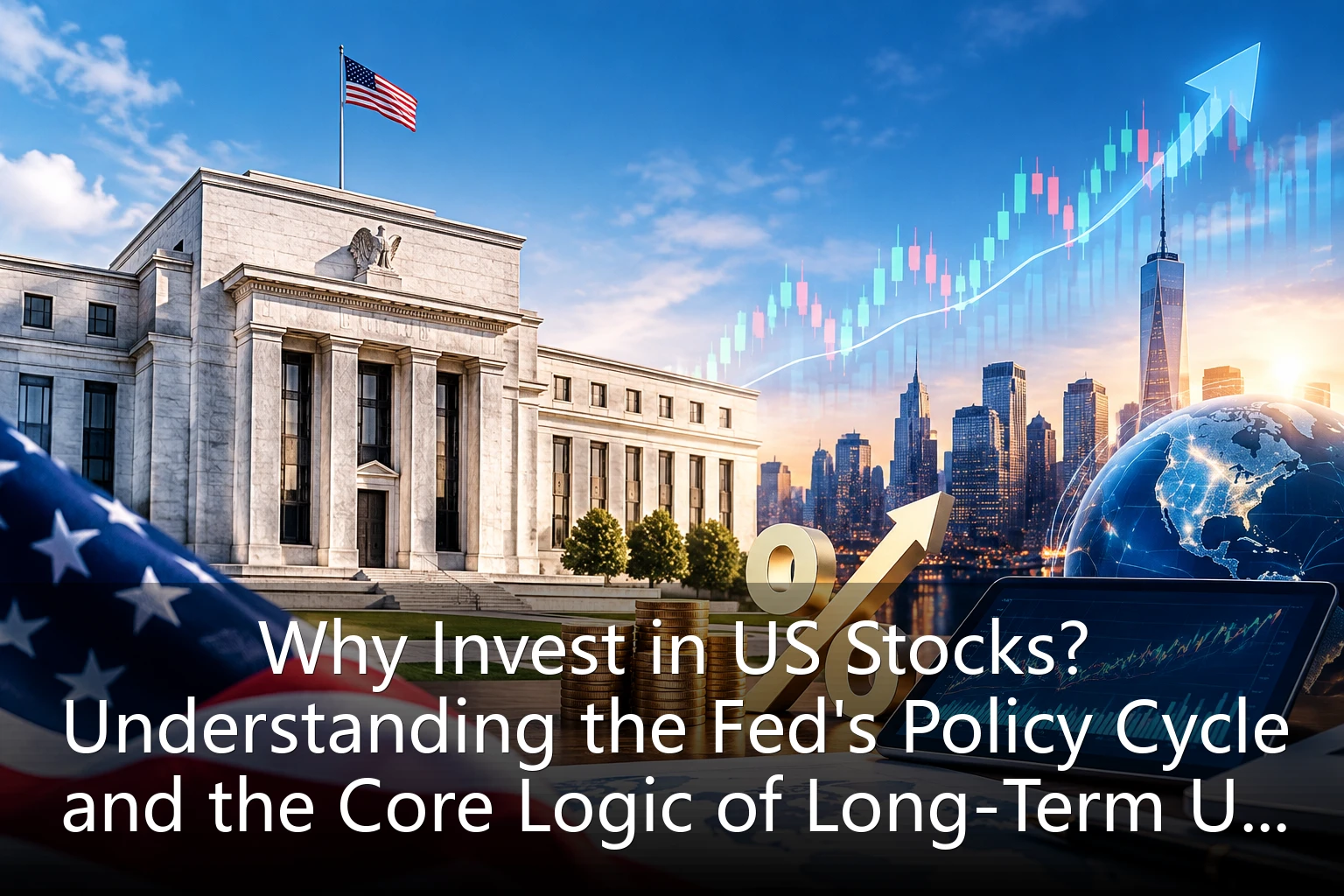
For many investors new to US stocks, candlestick patterns, earnings data, and valuation models certainly matter—but what truly determines the medium- and long-term direction of US equities is often an “invisible hand”: the Federal Reserve's monetary policy. To systematically answer the question “why invest in US stocks,” one cannot bypass an understanding of the Fed's policy cycle. This article will fully unpack the deep connection between monetary policy and US stock investing across four dimensions: interest rate transmission mechanisms, sector rotation patterns, institutional advantages, and practical strategies for everyday investors.
1. How Interest Rates “Conduct” US Stocks: Three Core Transmission Channels
1. Discount Rates and Valuation: A Simple Math Problem
The intrinsic value of a stock equals the discounted value of its future cash flows. When rates fall, discount rates decline accordingly, systematically raising the “present value” of distant earnings—especially favorable for growth companies whose profits materialize far in the future. Conversely, in a rising-rate phase, highly valued tech stocks often bear the brunt of the pressure. This also explains why, around every FOMC meeting, growth and value styles within the Nasdaq and the S&P 500 tend to diverge noticeably—rate expectations themselves are the baton that conducts style rotation.
2. Liquidity and Risk Appetite
Easing cycles not only lower corporate financing and refinancing costs but also inject ample liquidity into the financial system, boosting investors' willingness to allocate to risky assets; tightening cycles do the opposite—rising money market and short-term bond yields steadily siphon funds away from equities. The back-and-forth migration of capital between “stocks and bonds” and “growth and defense” forms the main thread of US equity volatility over the short to medium term.
3. The US Dollar and Global Capital Flows
Fed policy also influences global capital allocation through the dollar exchange rate. In strong-dollar cycles, capital tends to flow back into dollar assets; in weak-dollar cycles, emerging markets and commodities often benefit relatively. For US stock investors, this means dollar assets themselves are a dual destination for global capital—both a “safe haven” and a “profit seeker”—and this is one of the underlying reasons US stocks have long enjoyed a valuation premium.
2. Sector Rotation Across the Policy Cycle: The “Reference Script” History Provides
Reviewing easing and tightening cycles over the past few decades, we can distill some probabilistic patterns (which do not replay precisely every time):
- Early in a rate-cut cycle: rate-sensitive assets show the greatest elasticity; long-duration assets such as small caps, real estate investment trusts (REITs), and biotech often react first;
- Middle to late in easing: expectations of economic stabilization build, and cyclical sectors such as industrials and materials begin to take over;
- During a rate-hike cycle: net interest margins improve for financial firms such as banks and insurers, while sectors with stable cash flows, such as energy, hold up relatively well;
- During policy uncertainty: defensive sectors such as utilities, consumer staples, and healthcare become a haven for capital.
It must be emphasized that sector rotation is never a precise clock; the repeated interplay of macro data, earnings cycles, and policy expectations keeps rewriting the “script.” The real lesson for investors is not to bet on any single month's performance, but to figure out which link of the transmission chain their holdings occupy, and thereby understand the source of volatility.
3. Why the Fed Represents a Structural Advantage for Buying US Stocks
Zooming out, a mature and transparent monetary policy framework is itself a key reason US stocks have long attracted global capital:
- Highly transparent policy rules: a fixed meeting calendar, a pre-meeting blackout period, post-meeting policy statements and press conferences, the dot plot, and meeting minutes allow global investors to participate in pricing at the same time with equal information, greatly reducing information asymmetry;
- A clear and consistent pricing anchor: the 10-year Treasury yield serves as the benchmark for global asset pricing, giving equity valuations a comparable frame of reference; its valuation framework is far more interpretable and verifiable than that of most markets;
- Healthy interaction between policy and markets: rate futures price the policy path in real time, and the Fed calibrates policy with reference to financial market conditions; this two-way feedback makes the US stock market's efficiency in digesting macro changes second to none globally.
By contrast, some emerging markets suffer from insufficient central bank transparency, compounded by currency volatility and capital controls. This is one of the classic answers to “why dollar assets should come first in global asset allocation”: what you buy is not just a basket of great companies, but an entire set of mature market institutions and rules.
4. How Everyday Investors Can Turn the Policy Cycle into Strategy
1. Allocate with a Cycle Mindset, Not Precise Timing
Even seasoned economists struggle to consistently guess FOMC outcomes. A more workable approach: moderately raise equity exposure and add long-duration assets during easing cycles; hold more cash and defensive assets during tightening or highly uncertain phases. Treat the “cycle” as a regulator of your allocation range, not a starting gun for entries and exits—that is how you avoid being jerked around by the noise of any single decision.
2. Core-Satellite Structure: Index Foundation with Thematic Enhancements
Use broad index funds such as the S&P 500 and Nasdaq 100 as your core position to capture the long-term compounding of US equities as a whole; then use a small satellite allocation to participate in the more elastic directions of the policy cycle, such as small-cap indexes, REITs, or sector-specific ETFs. This structure neither misses the cycle's dividends nor carries the risk of a single bet, making it especially suitable for everyday investors with limited time and energy.
3. Watch Three Key Signals
- Inflation and jobs data: price and labor market reports are core variables in the policy path; whether data beat or miss expectations directly rewrites the market's pricing of rates;
- Treasury yields and the yield curve: the direction of the 10-year Treasury yield is the most direct “thermometer” for growth stock valuations, while the curve's shape embeds expectations for the economic cycle;
- The dot plot and minutes wording: the degree of internal divergence within the Committee on the rate path is often more telling than the decision itself.
4. Don't Forget the Other Side of Risk
Policy is a double-edged sword. If resurgent inflation forces rates “higher for longer,” drawdowns in highly valued growth sectors could be severe; if easing comes too fast and too hard, it may plant the seeds of asset bubbles and currency volatility. Position sizing, staged entry, and a long-term perspective will always be more reliable than predicting the outcome of any single meeting.
Conclusion: Treat the Fed as an “Ally,” Not a “Puzzle”
Back to the original question—why invest in US stocks? Beyond the depth of the tech industry, the concentration of the world's best companies, and unmatched market depth, a highly transparent, trackable, and researchable monetary policy framework gives everyday investors, for the first time, a seat at the same table as global giants. Understanding the Fed is not about learning to predict every decision; it is about building a mental framework for understanding the sources of US stock volatility. Only when the policy cycle, corporate earnings, and valuation levels are placed on the same map does the roadmap for long-term US stock investing truly come into focus.