

Microsoft Earnings Ignite AI Application Monetization Hopes, Nasdaq Hits Record High on First Day of August
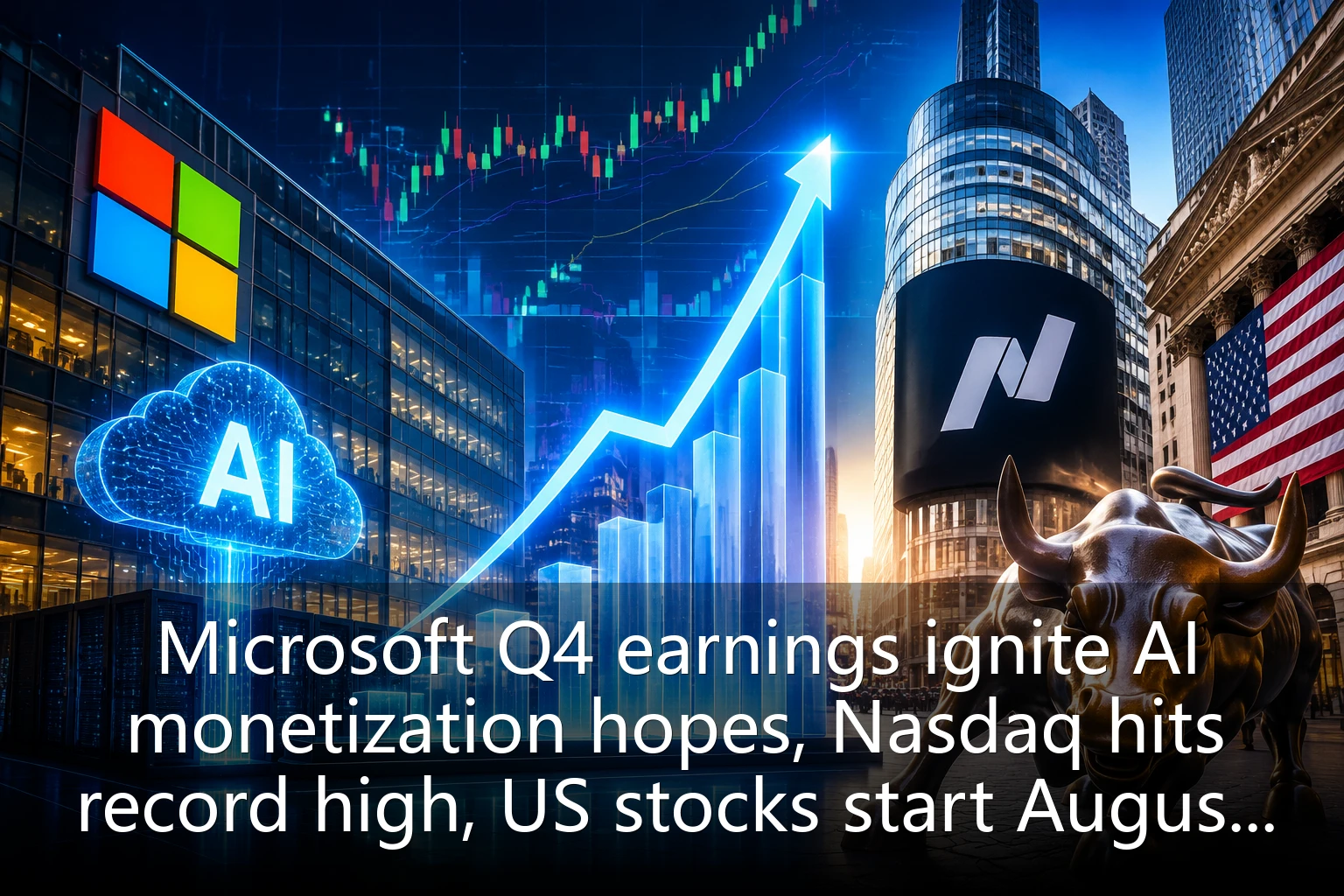
On August 1, 2026, the US stock market kicked off the third quarter with a strong start. Boosted by robust tech earnings, the Nasdaq Composite Index opened higher and surged, breaking through the 22,500-point mark for the first time intraday to set a new record high. The S&P 500 also performed strongly, closing up 1.2% and approaching its previous peak, while the Dow Jones Industrial Average was relatively steady, edging up 0.4%. The biggest catalyst for this rally was software giant Microsoft's Q4 fiscal 2026 earnings report, released after the market close in late July. The report showed that Microsoft not only beat Wall Street expectations on both total revenue and earnings per share, but also revealed that AI revenue growth within its Azure cloud services reached a staggering 65%, completely igniting market enthusiasm for "AI application monetization."
Microsoft Earnings Key Data: The Leap from "Buying Compute" to "Selling Subscriptions"
According to Microsoft's latest earnings report, total revenue for the fourth fiscal quarter reached $68 billion, an 18% year-over-year increase, with net profit of $22 billion, up 21%. This robust data not only signals stability but also reveals that the AI business model's closed loop is accelerating. Over the past two years, capital market hype around AI focused mainly on the "pick-and-shovel" narrative—where chip companies like Nvidia profited immensely from selling computing hardware. Microsoft's latest earnings, however, prove to Wall Street that the "gold rush" era for AI applications has arrived.
Earnings details show that revenue from the Intelligent Cloud segment, which includes services like ChatGPT, grew 30% year-over-year, with AI's contribution to Azure exceeding 15% for the first time. More importantly, enterprise subscriptions for Microsoft Copilot (AI assistant) surpassed the 30 million mark in Q4, with over 8 million new additions in a single quarter. This means AI is no longer just a cash-burning R&D project but is beginning to translate into tangible recurring revenue (ARR).
Industry Interpretation: A Historic Shift in AI Trading Logic
Agusight Financial Research believes the landmark significance of Microsoft's earnings is that it marks the official shift in US stock AI trading logic from "hardware infrastructure" to "software application monetization." Previously, the market worried that AI computing investments could not be recouped through the application layer, posing a bubble risk for tech stock valuations. However, the rising penetration of Microsoft Copilot validates that enterprise users are willing to pay a premium for AI tools that boost productivity.
- Valuation System Restructuring: Valuations for hardware-layer companies (like NVIDIA) will gradually revert to cyclical stock logic, constrained by capital expenditure cycles, while application-layer companies (like Microsoft, Adobe, Salesforce) will command higher SaaS valuation premiums.
- Competitive Moat Shift: Tech giants with massive user bases and diverse business scenarios will find it easier to achieve commercial monetization than pure AI model startups. The data flywheel effect will reinforce the strong-get-stronger dynamic.
- Structural Change in Capital Expenditure: Enterprise IT spending will shift from traditional software and hardware maintenance towards integrated AI solutions, boosting the overall prosperity of the software services sector.
Market Sentiment and Sector Rotation: Funds Are Quietly Reallocating
Market data confirms this logical shift. On August 1, the software services sector ETF (IGV) within the Nasdaq Composite surged 3.5%, far outpacing the 1.2% gain of the semiconductor sector ETF (SMH). Besides Microsoft, traditional SaaS giants like Adobe and Salesforce also recorded significant gains, indicating that funds are positioning for a catch-up rally in AI applications.
Meanwhile, the CBOE Volatility Index (VIX fear gauge) fell back to around 12, a historically low level, suggesting extremely optimistic market sentiment. However, beneath this optimism, we also observed some warning signals:
- Some funds are taking profits from semiconductor leaders that have surged significantly this year and rotating into lagging software and cybersecurity sectors.
- Small and mid-cap tech stocks underperformed large-cap tech stocks, with the Russell 2000 Index rising only 0.3% on the day. Market breadth did not widen with the index, as funds remained concentrated in mega-cap leaders.
- The US 10-year Treasury yield rebounded above 4.3%, and the sensitivity of high-valuation tech stocks to interest rates could re-emerge as a disruptive factor in the second half of the year.
Investment Strategy: US Stock Allocation Suggestions for August
At this juncture in August, with all three major US stock indices at high levels, how should investors position themselves? Agusight Financial offers the following asset allocation and investment insights for global investors:
1. Balanced Allocation Between "Compute" and "Applications": We do not recommend chasing the semiconductor sector at current levels. Instead, focus on software giants that have undergone sufficient correction and possess the ability to generate AI subscription revenue. Microsoft's earnings have set a precedent; subsequent focus should be on Google Cloud's AI progress and Meta's moves in commercializing open-source large models.
2. Beware of "Sell the News" During Earnings Season: Historical experience shows that when market expectations are extremely high, even better-than-expected earnings can sometimes trigger a "sell the news" pullback. For short-term traders, the sharp drop in options volatility post-earnings can be an opportunity to implement short straddle strategies to capture time value.
3. Monitor the Macro-Level Liquidity Inflection Point: The Federal Reserve's September FOMC meeting will be a key event in the second half of the year. The market has fully priced in a "soft landing" scenario. If subsequent inflation data (especially core PCE) proves sticky, high-valuation tech stocks could face a valuation correction risk. We recommend investors appropriately allocate to defensive sectors like healthcare and consumer staples in their portfolios to hedge against potential systemic risks.
Summary: US Stocks Live View—Anchors for the August Rally
Overall, the US stock market's start in August 2026 is positive, with Microsoft's earnings injecting a new narrative driver. The Nasdaq's new high demonstrates tech stocks' resilience, but internal sector rotation is quietly underway. For investors tracking real-time US stock market movements, the next key is to monitor the penetration rate of AI business in more corporate earnings reports, using this as the core anchor for identifying structural opportunities within the tech sector. Maintaining a degree of sobriety amidst the frenzy and seeking certainty within the divergence will be the key to winning in US stock investing in the second half of the year.