


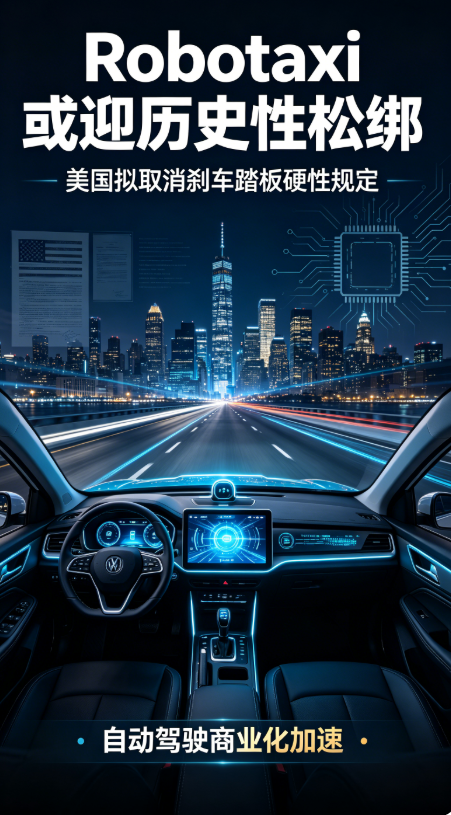
The US plans to lift the mandatory brake pedal requirement for driverless cars, marking a crucial leap for the commercialization of Robotaxis
Key words: Autonomous driving, driverless cars, brake pedals, Robotaxis, NHTSA, Tesla, Waymo, regulatory reform
Introduction
The core of regulatory easing: ";" "Pure autonomous driving" Make way
This proposal is not aimed at all vehicles but is explicitly limited to ";" "Pure autonomous driving" Vehicle models refer to those that do not require human drivers to operate from the very beginning of their design. For self-driving cars that still retain manual driving functions, the current safety standards will remain unchanged, and traditional control devices such as brake pedals must still be retained.
The NHTSA emphasized that the removal of the brake pedal requirement does not mean relaxing the safety bottom line. On the contrary, vehicles still need to meet strict braking performance standards, such as braking distance, emergency braking capacity and road stability, etc. This means that the focus of regulatory reform is not to undermine safety, but to make safety standards more in line with the actual operational logic of autonomous driving technology: since vehicles no longer rely on human drivers, it is necessary to re-evaluate some of the hard requirements established around human operation habits.
What does this mean for Robotaxi? For the Robotaxi industry, the brake pedal is not merely a mechanical component but a long-standing institutional threshold. Traditional safety regulations were formed decades ago when autonomous driving had not yet emerged. The regulations tacitly stipulated that the driver's seat must be taken over in real time by a human. Therefore, many vehicle models that have removed devices such as steering wheels and pedals often face complex exemption approval procedures before entering the market. The approval period is long and the policy uncertainty is high, which directly affects the mass production and commercialization pace of enterprises.
If this reform proceeds smoothly, it is expected to reduce enterprises' reliance on the exemption mechanism and make it easier for models specifically designed for driverless vehicles to obtain road access. This change is particularly important for Tesla. Musk has been promoting the establishment of a unified and clear federal-level regulatory framework for autonomous driving, and the Cybercab he envisions is a typical example. No steering wheel, no pedals. Design. If the regulatory environment becomes more friendly, the commercialization of similar vehicle models will be more realistic.
Industry competition accelerates, and regulation becomes the decisive factor
The competition in the current Robotaxi market in the United States has significantly intensified. Waymo, with its early layout and relatively mature operation system, has deployed thousands of Robotaxis in 11 cities and plans to expand to 20 cities by the end of the year. Zoox, relying on Amazon's resources, continues to advance the research and development of dedicated unmanned vehicles. In contrast, Tesla's Robotaxi business is still in a relatively early stage. Although it has expanded in places like Austin, Dallas and Houston in Texas, the size of its fleet is still less than 100 vehicles.
This means that the competition in Robotaxi is no longer merely a contest of technical routes, but rather a comprehensive competition of regulatory adaptability, product definition capabilities, and large-scale operation capabilities. Whoever can adapt to regulatory reforms first and launch models truly designed for driverless scenarios will have a greater chance of seizing the future market.
Regulatory modernization still faces practical challenges. However, policy relaxation does not mean that the industry will take off immediately. The large-scale popularization of autonomous driving is still constrained by three major factors: technological maturity, capital investment and consumer acceptance. Firstly, the system must remain stable and reliable in complex road environments, which places extremely high demands on perception, decision-making, and redundant safety design. Secondly, the research and development as well as operation costs of dedicated unmanned vehicles remain relatively high. Finally, the public is concerned about ";" No steering wheel, no pedals. Whether the way of taking a vehicle is trustworthy enough still needs time to be cultivated.
In addition, there are still deeper issues at the regulatory level that have not been fully resolved, such as whether steering wheels will also become the target of future reforms, how to formulate unified safety standards for ADS in real road environments, and how to coordinate cross-state operation rules, etc. It can be said that eliminating the brake pedal is just the first step; there is still a series of institutional restructuring tasks to be completed.
Conclusion The U.S. Department of Transportation is pushing for the removal of the mandatory brake pedal requirement for driverless cars. On the surface, this seems to be a technical detail adjustment, but in essence, it represents a shift in the autonomous driving industry from ";" "Experimental exploration" "Heading towards";" "Institutionalized operation" A crucial step. It sends out a clear signal: regulation is shifting from being centered on human drivers to being centered on autonomous driving systems.
For companies like Tesla, Waymo and Zoox, this not only means an expanded space for product design, but also implies that their business models are expected to become clearer. In the future, what will truly determine whether Robotaxis can be widely implemented on a large scale, apart from policy support, will also be a comprehensive breakthrough in technical safety, cost control and user trust. Regulatory modernization has already been initiated, but the real competition in the autonomous driving industry has only just entered the deep water zone.